The concept
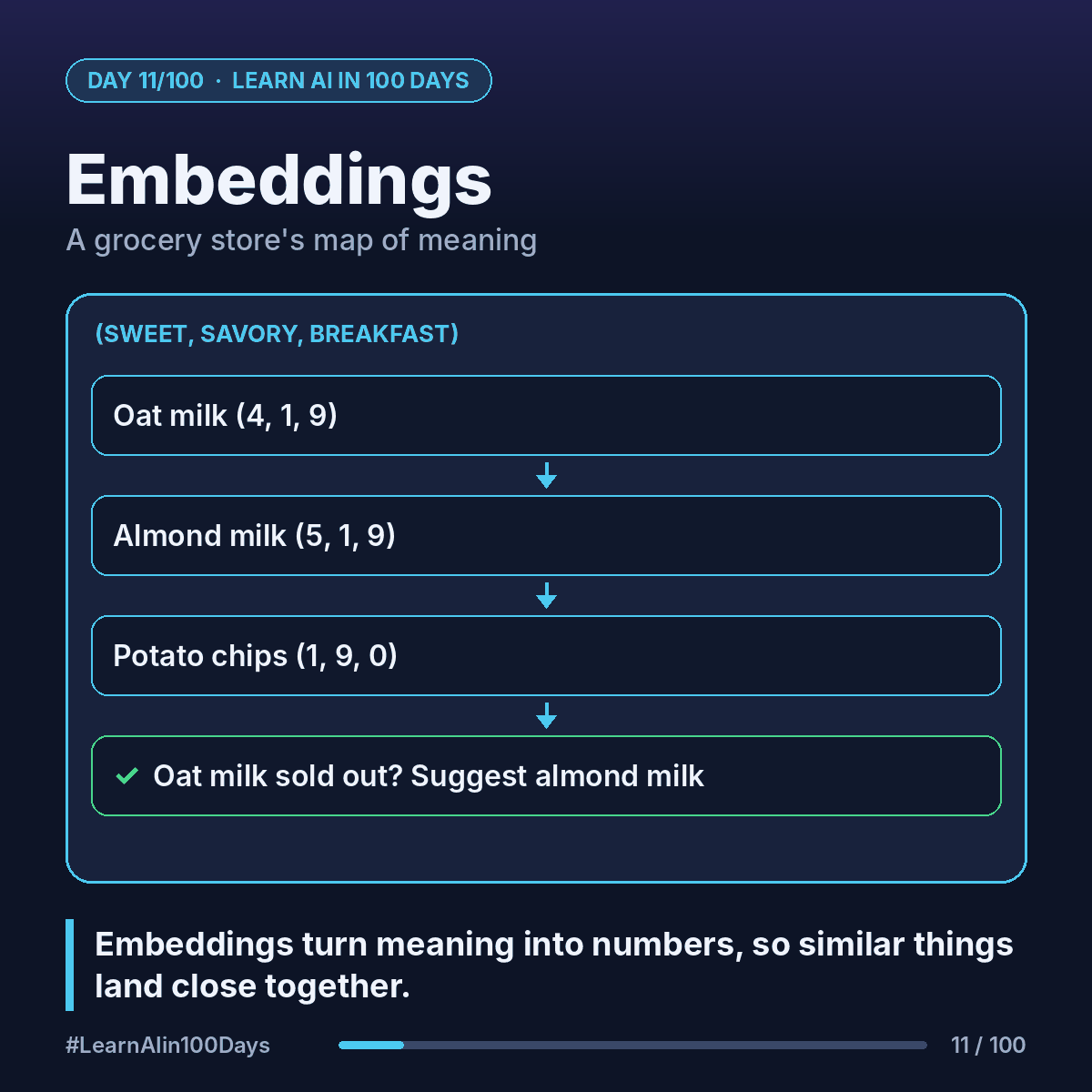
An embedding is a list of numbers that represents the meaning of something: a word, a sentence, a product, a song.
The trick: things with similar meaning get similar numbers, so they sit close together on a map of meaning. Distance on the map = difference in meaning.
Walkthrough: a grocery stores map of products
Imagine describing each product with just 3 numbers, each from 0 to 10: (sweet, savory, breakfast-y)
- Oat milk: (4, 1, 9)
- Almond milk: (5, 1, 9)
- Cereal: (6, 1, 10)
- Potato chips: (1, 9, 0)
- Salsa: (2, 8, 1)
Compare:
- Oat milk vs almond milk: differ by just 1, on one number. Neighbors.
- Oat milk vs potato chips: differ by 3, 8 and 9. Far apart.
So when a shopper wants oat milk and its out of stock, the store suggests the closest item: almond milk. No one wrote a rule saying these are substitutes. The numbers say it.
Real AI differs in two ways:
- Embeddings have hundreds or thousands of numbers, not 3.
- Nobody chooses what each number means. The model learns them from data, for example from which products get bought together, or which words appear in similar sentences.
Thats why the individual numbers in a real embedding usually have no human-readable meaning. Only the distances matter.
Why this is a big deal
Embeddings let AI work with meaning, not exact words:
- Search laptop wont turn on and find the article titled PC fails to power up.
- Group 10,000 customer comments by topic without reading them all.
- Recommend things similar to what someone liked.
They're also the foundation for semantic search and RAG, which well build up to on Days 29–31.
Where you see it at work
- Retail: similar items and customers also bought.
- Banking: matching a customers question to the right help article.
- Insurance: finding past claims that resemble a new one.
- Product management: clustering feature requests by theme.
In one sentence
An embedding turns meaning into a list of numbers, so similar things land close together and AI can measure similarity with simple math.