The recap
Phase 3: Large language models
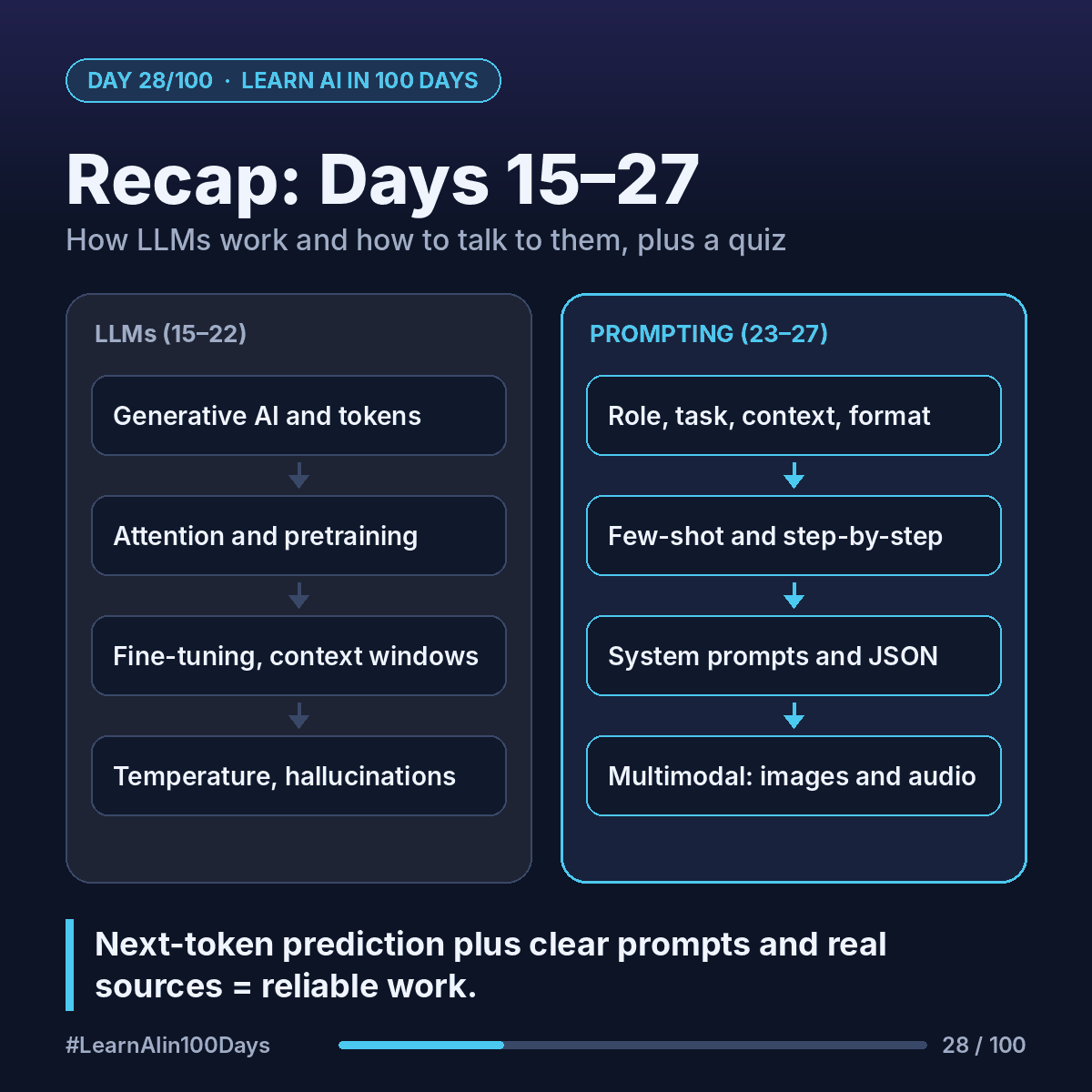
15. Generative AI creates new content (a claim letter) instead of picking a label (fraud / not). One word at a time.
16. Tokens are the pieces a model reads, roughly ¾ of an English word each. You pay and hit limits in tokens.
17. Transformers use attention: every word looks at every other word to work out what "it" means.
18. Pretraining = guessing the next word billions of times. Knowledge stops at a cutoff date.
19. Fine-tuning teaches a house style from examples; RLHF teaches preferences from people's picks.
20. The context window is the model's working memory. Overload it and details get lost in the middle.
21. Temperature controls randomness: high for taglines, low for facts.
22. Hallucinations are confident, plausible text that isn't true. Ground them in sources and verify.
Phase 4: Talking to models well
23. A good prompt has role, task, context, format and constraints.
24. Few-shot = show a few labeled examples. Step-by-step = ask it to show its working.
25. System prompts set the rules and identity; user and assistant messages are the conversation.
26. Structured outputs (JSON) let apps use the answer. Define a schema and validate it.
27. Multimodal models read images, audio and text together, but a human still checks what they "see".
The quiz (answers below, no peeking)
Q1. A product owner's prompt is just "summarize this". Name three things to add.
Q2. You want 20 fresh name ideas for a savings account. Raise or lower the temperature?
Q3. A chatbot confidently cites "Policy section 9.2", which doesn't exist. What's that called? One fix?
Q4. 2,000 support emails × 400 tokens each. How many tokens is that?
Q5. Your app reads invoice amounts from the model's reply and keeps breaking on chatty extra text. What should you ask for?
Answers
A1. Any three: role, context (who reads it, why), format, constraints like length.
A2. Raise it for more variety.
A3. A hallucination. Fix: give it the real policy text and ask it to cite.
A4. 800,000 tokens.
A5. Structured output: JSON that matches a schema you define, then validate it.
5/5? You're ready for Phase 5.
In one sentence
An LLM predicts the next token from patterns; clear prompts, real sources and structured output make it reliable at work.
Phase 5 next: giving models your own knowledge with search, vector databases and RAG.