The concept
In regulated industries, a useful agent rarely makes the final call. It does the legwork around a decision:
- Read: the request or form that starts the work.
- Gather: pull records it is allowed to read (tools, Day 37).
- Check: compare against written policy or criteria (RAG, Day 31).
- Draft: a summary, letter or next step, citing sources.
- Hand off: a person approves, edits or rejects (Day 44).
- Log: every step recorded for audit.
Same shape as MeetingMate (Days 86–96).
Walkthrough: a prior authorization packet
Prior authorization: a health plan's approval needed before some treatments or scans are covered. Clinic staff often assemble these requests by hand.
One knee MRI request, illustrative:
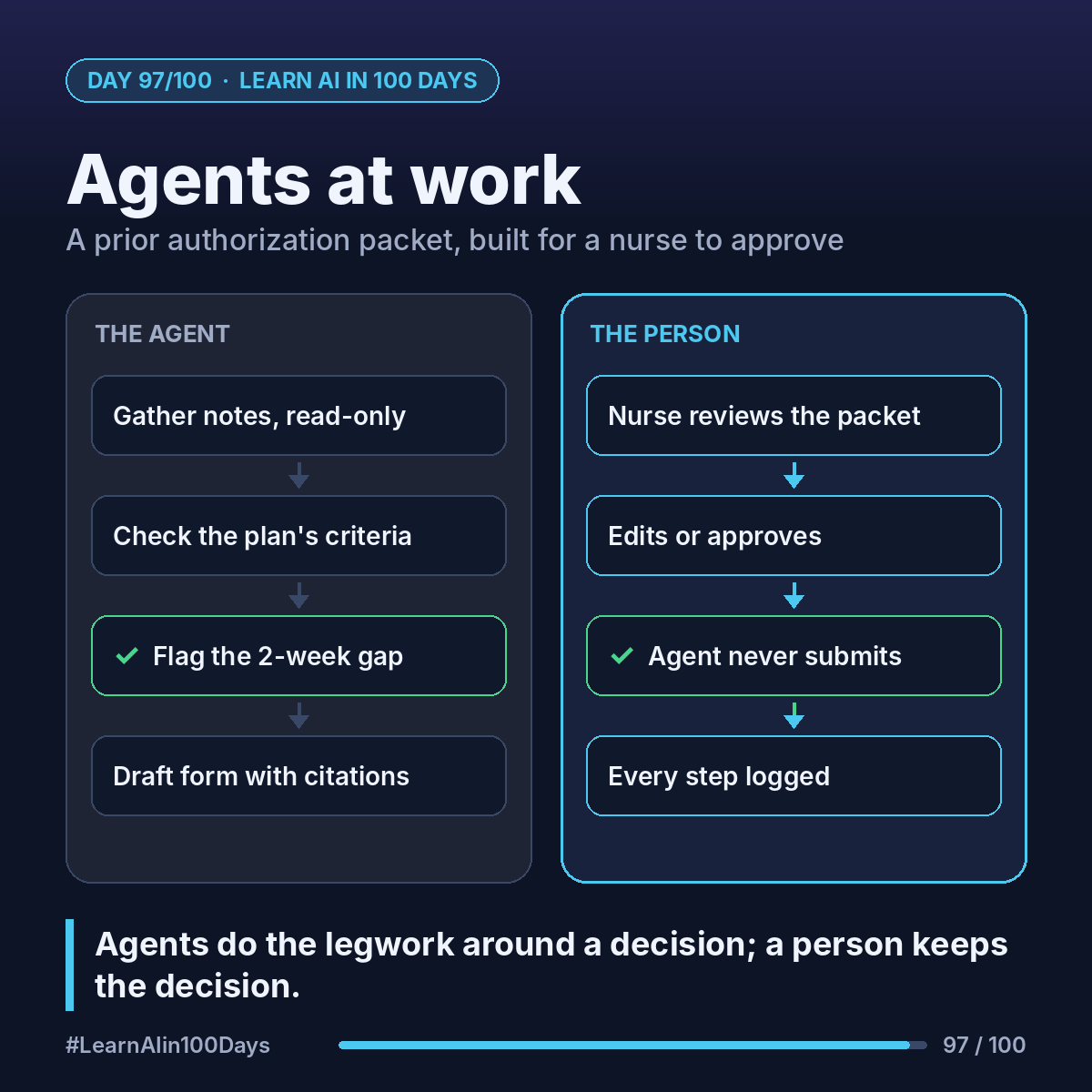
1. Trigger: a doctor orders the MRI; the agent sees this plan requires prior authorization.
2. Gather: it pulls visit notes, the X-ray result and therapy history, read-only.
3. Check: it compares them with the plan's published criteria, e.g. "6 weeks of physical therapy first".
4. Gap: the notes show 4 weeks, not 6. The agent doesn't guess; it flags the gap to staff.
5. Draft: once complete, it fills the form and a short justification citing each note.
6. Human: a nurse reviews and submits. The agent never submits on its own.
7. Log: what it read, drafted, and who approved.
The value is time and completeness. Accountability stays with people.
Where you see it at work
Banking
- Card disputes: gather the transaction, merchant and customer statement into one case file.
- KYC refresh (know your customer): find expired documents and draft the request to the client.
- Fraud alerts: summarize why an alert fired, so the investigator starts faster.
Insurance
- Underwriting intake: extract a broker's submission, flag missing items, route it.
- Policy servicing: draft answers grounded in the actual policy wording.
Healthcare
- Clinical notes: draft a visit note from a consented recording; the clinician edits and signs.
- Referrals: route to the right specialty, flag urgent ones for a person.
Across all three: read-only first, narrow tools, cited sources, a human approving anything that moves money, coverage or care.
Your action today: map one process at work to the six steps. Where exactly does the human checkpoint go?
In one sentence
Agents at work do the legwork around a decision (gather, check, draft, log) while a person keeps the decision.
Which process in your industry would you hand to an agent first, and where would the human stay? 👇