The concept
An agent pattern is a reusable way to arrange model calls, tools and code. Like process diagrams: a few shapes, endless combinations.
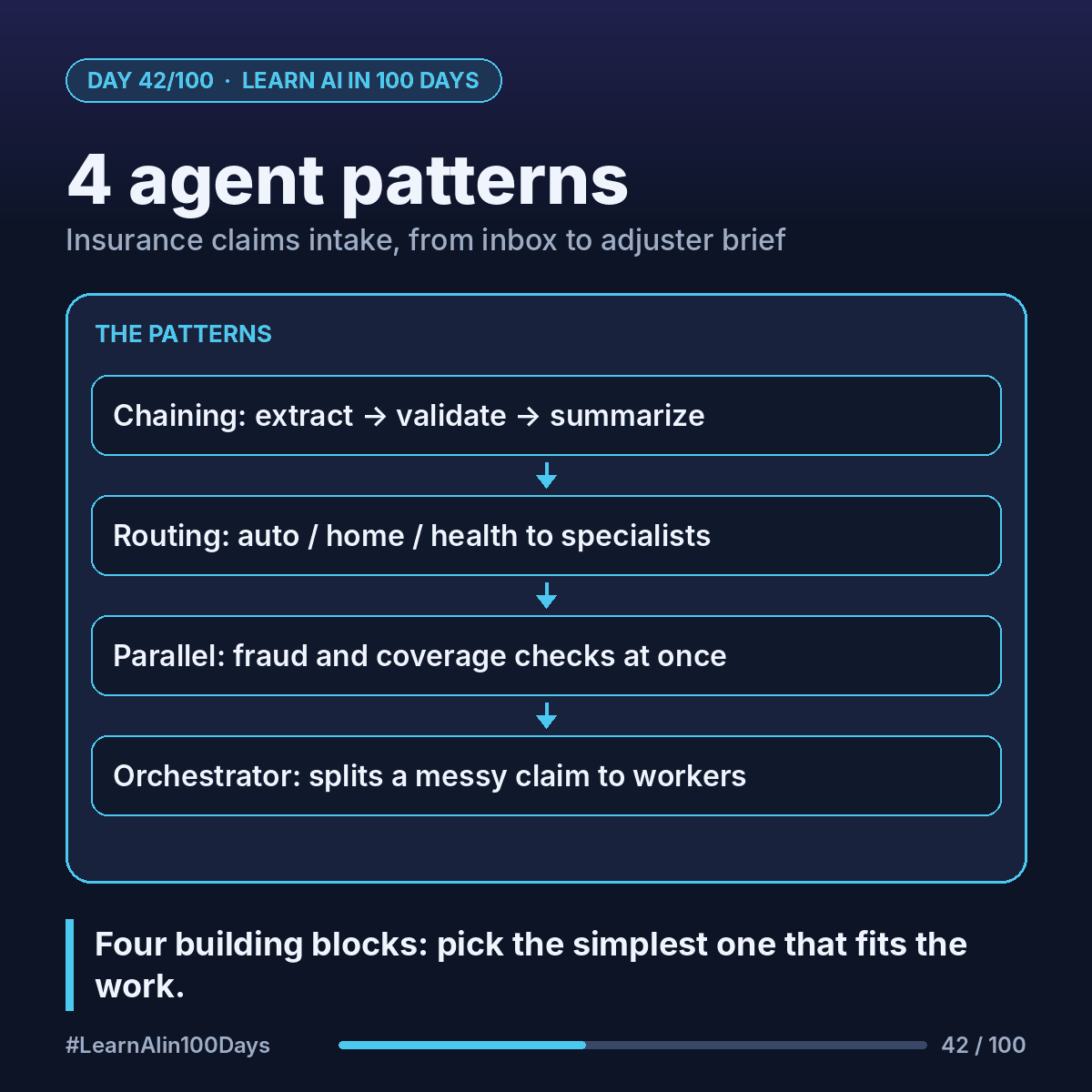
Four you'll see everywhere:
- Chaining: step A's output feeds step B, then C. Each step is small and checkable.
- Routing: first classify the input, then send it to the specialist that fits.
- Parallel: run independent checks at the same time, then combine the results.
- Orchestrator–workers: one coordinator splits a task, hands out subtasks, and assembles the answer.
Walkthrough: insurance claims intake
Imagine 2,000 first notice of loss emails a week.
1) Chaining: extract → validate → summarize
- Extract: policy number, date of loss, claim type, description.
- Validate (plain code, not AI): is the policy active on that date? Any required field missing?
- Summarize: a 5-line brief for the adjuster.
If validation fails, the chain stops and asks for the missing info.
2) Routing: auto / home / health
- A quick classifier reads the claim and picks a lane.
- Each lane has its own specialist prompt: collision rules for auto, water vs fire damage for home, benefit codes for health.
3) Parallel: fraud check and coverage check at once
- Neither needs the other's answer.
- Say each takes 20 seconds. In sequence: 40 seconds. In parallel: about 20.
4) Orchestrator–workers: the messy claim
- A home claim mentions a burst pipe, a damaged car in the garage and a hotel stay.
- The orchestrator splits it: a worker for home damage, one for auto, one for additional living expenses.
- It merges the three findings into one summary for the adjuster.
Which pattern when?
- Steps always the same? Chaining.
- Inputs come in clear types? Routing.
- Checks independent of each other? Parallel.
- Can't know the subtasks until you see the input? Orchestrator–workers.
Start simple. More moving parts means more cost and more places to fail.
Where you see it at work
- Insurance: intake, triage and adjuster briefs, with humans deciding the claim.
- Banking: routing customer messages to disputes, cards or lending.
- Healthcare: chaining prior-authorization requests: extract, check criteria, draft.
- Business analysis: these map onto the process flows you already draw.
In one sentence
Chaining, routing, parallel and orchestrator–workers are building blocks; pick the simplest one that fits the work.