The concept
Structured output: asking the model to reply in a fixed, machine-readable format instead of free text. The most common format is JSON.
JSON (JavaScript Object Notation): a simple text format of "key": value pairs inside curly braces. Readable by people, easy for software to parse.
Schema: the agreed shape of the JSON. Which fields, what type each one is (text, number, date), which are required.
Many model APIs can enforce a schema directly; check your provider's docs for the option.
Walkthrough: accounts payable inbox
The email:
"Hi team, attached is our bill for March cleaning services. Inv# BR-2291. Total comes to $4,350.00, please pay by April 15 2026. Thanks, Maria, BrightClean Facilities"
Step 1: define the schema.
- vendor_name: text, required
- invoice_number: text, required
- amount: number, required
- currency: text, required
- due_date: date (YYYY-MM-DD), required
Step 2: prompt.
"Extract these fields from the email. Return only JSON matching the schema. If a field is missing, use null. Don't guess."
Step 3: model output.
{"vendor_name": "BrightClean Facilities", "invoice_number": "BR-2291", "amount": 4350.00, "currency": "USD", "due_date": "2026-04-15"}
Notice: "Inv#" became invoice_number, "$4,350.00" became the number 4350.00, "April 15 2026" became a standard date.
Step 4: validate before anything gets paid.
- Is it valid JSON with every required field?
- Is amount a positive number? Is due_date a real date?
- Is the vendor in the vendor master? Does the amount match the PO?
- Anything that fails or comes back null goes to a person.
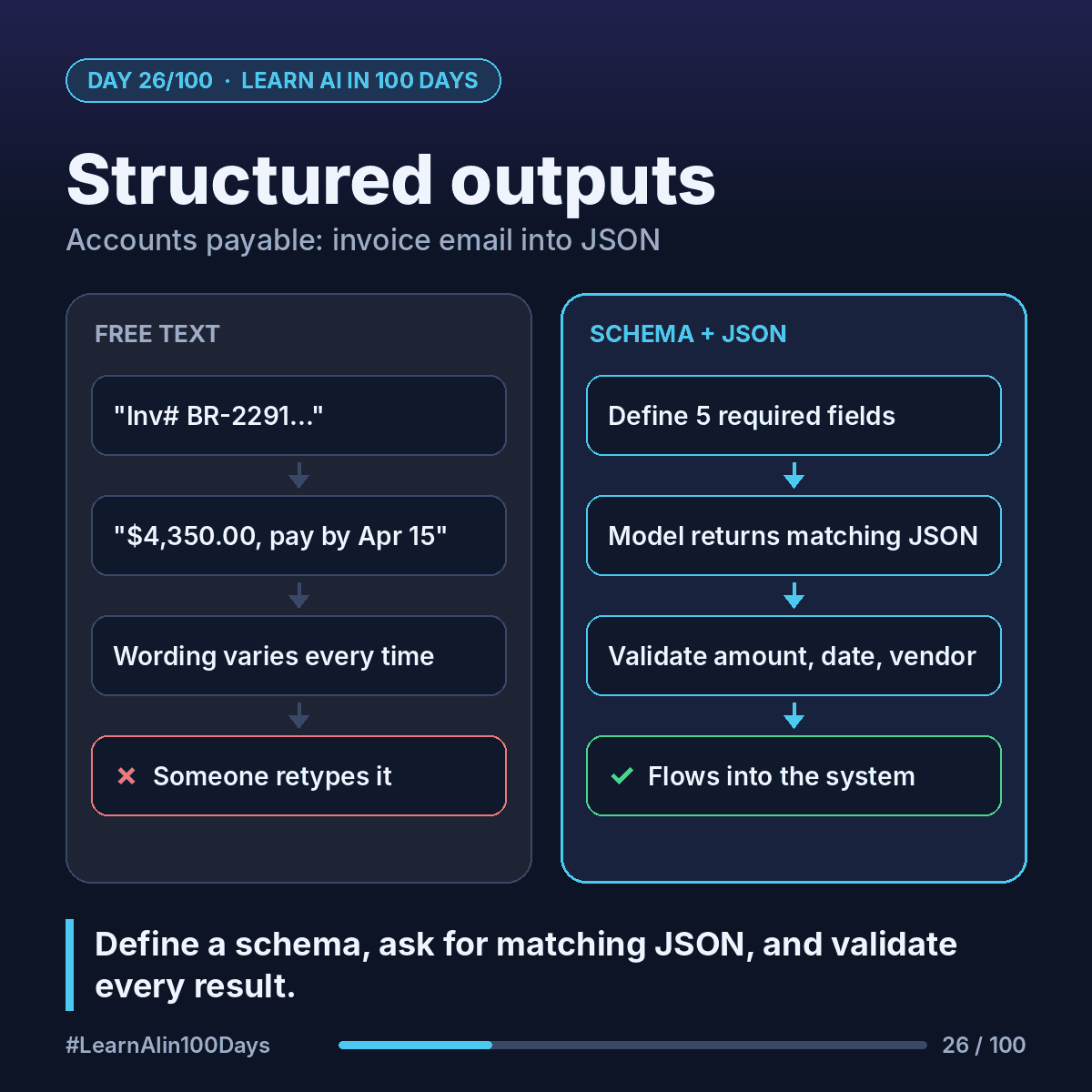
Why apps need this: free text changes wording every time. A fixed schema lets the next system (ERP, workflow, database) use the result without retyping.
Where you see it at work
- Banking: pulling key terms from loan documents into fields for review.
- Insurance: turning a first notice of loss email into a claim record.
- Healthcare: extracting referral details (patient ID, reason, urgency) into a queue, with staff verification.
- Business analysis: the schema is a data contract. Define fields, types and rules with the downstream team first.
In one sentence
Define a schema, ask the model for JSON that matches it, and validate every result, so AI output can flow into real systems instead of being copied by hand.