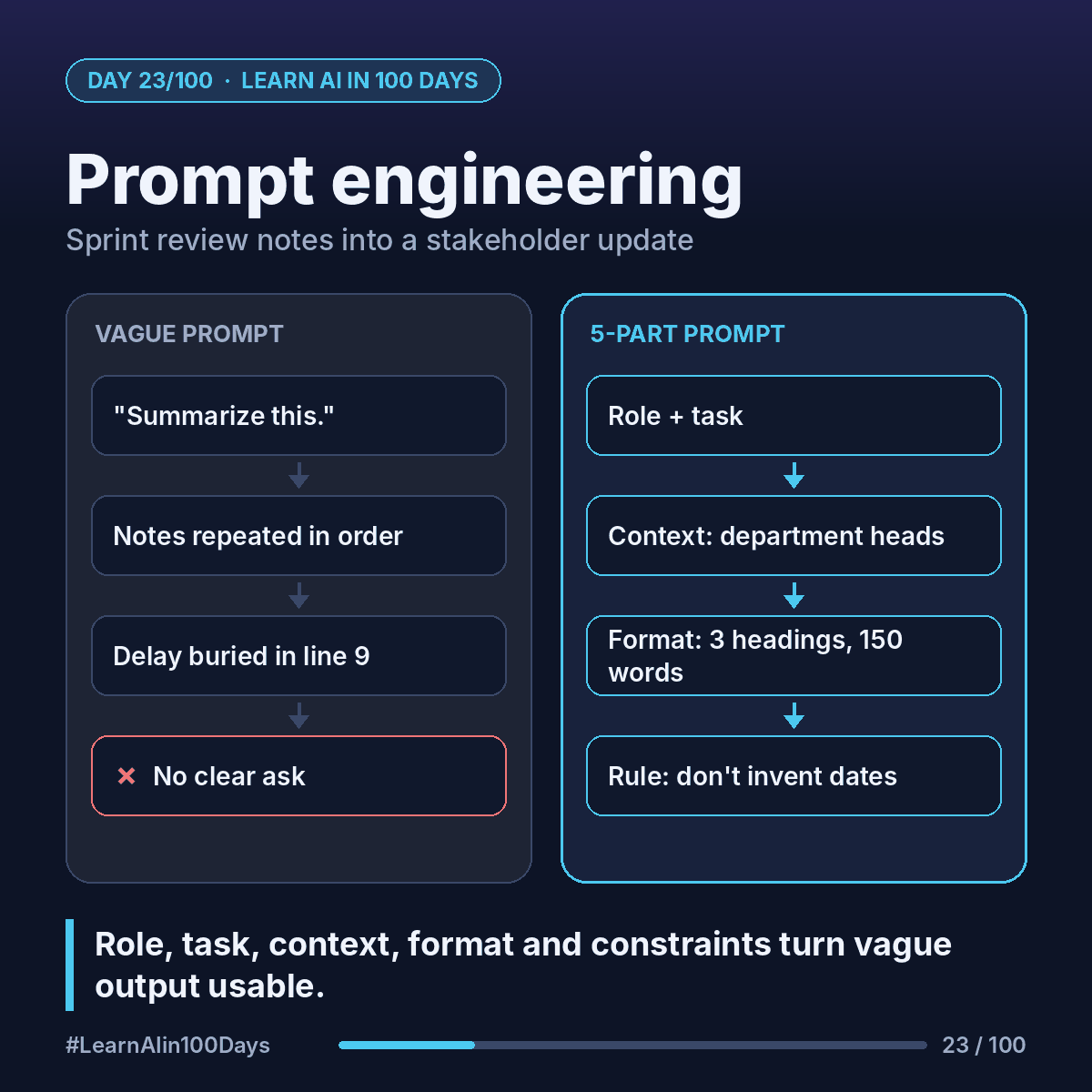
The concept
Prompt engineering: writing your request so the model has what it needs to do the job well. No code, just clear instructions.
The model can't read your mind or your org chart. Anything you leave out, it guesses (and guessing is where hallucinations start, Day 22).
A simple checklist that works for most tasks:
- Role: who should it act as?
- Task: what exactly should it produce?
- Context: who is it for, and what do they care about?
- Format: length, structure, sections.
- Constraints: what to avoid, what to do if info is missing.
Walkthrough: sprint review notes → stakeholder update
You're a product owner with 2 pages of raw sprint review notes: half-sentences, ticket numbers, a debate about a delayed integration.
Before:
"Summarize this."
What you get: a long paragraph that repeats the notes in order, uses team jargon, buries the delay in line 9 and has no clear ask.
After:
"You are a product owner writing to business stakeholders. [Role]
Turn the sprint review notes below into a status update. [Task]
Readers are department heads who don't follow ticket numbers. They care about delivery dates, risks and decisions they need to make. [Context]
Use 3 headings: Delivered, At risk, Decisions needed. Max 150 words, bullets, plain language. [Format]
Don't invent dates or numbers. If something is unclear in the notes, list it under 'To confirm'. [Constraints]
Notes: <paste notes>"
What you get: a short update that leads with what shipped, flags the integration delay with its impact, and asks one clear question: "Approve moving the launch by one sprint?"
Same model. Better brief, like a good handover to a new teammate.
Then iterate ("Shorter. Put the risk first.") and save prompts that work as team templates.
Where you see it at work
- Product management: release notes, sprint updates and backlog summaries for different audiences.
- Business analysis: turning workshop notes into draft user stories with acceptance criteria.
- Banking: rewriting a policy change into plain-language customer messages, with compliance review after.
- Insurance: summarizing a long claim file into a one-page brief for the adjuster.
In one sentence
Give the model a role, a clear task, the context, the format you want and the rules to follow, and a vague answer becomes a usable one.